Choosing Heavy Duty Concrete Anchors: Application Fit and Specification Checks
THE BUYER'S GUIDE / SELECTION
Choosing Heavy Duty Concrete Anchors: Application Fit and Specification Checks
A buyer-focused guide to choosing heavy duty concrete anchors from Handan Boen Fastener Manufacturing Co., Ltd. It compares two documented options, a fluted-sleeve heavy duty concrete anchor and a post-installed single-tube undercut concrete anchor, by load type, application, corrosion protection, installation tooling and documentation. It also lists the points buyers must confirm on a spec sheet before ordering.

Substrate: both documented products are described for concrete only; other masonry is not covered
Load type: vibration and cyclic loads (fluted sleeve anchor) versus structural and seismic connections (undercut anchor)
Holding principle: sleeve and ribbed shank expansion versus mechanical interlock in an undercut cavity
Installation tooling: drill, insert, tighten versus rotary hammer plus mandatory undercutting drill bit and 35 Nm nut torque
Corrosion protection: zinc-plated carbon steel with 500+ hours salt spray for the fluted sleeve anchor
Documentation: published test data (M10 pull-out values per ASTM E488) and the spec sheets available on request for the required sizes
Choosing Heavy Duty Concrete Anchors: Application Fit and Specification Checks
Choosing heavy duty concrete anchors starts with the job, not the catalog. Before comparing products, procurement teams should write down a few basic constraints: the base material, the load type (static, cyclic or seismic), what is being fixed, the service environment, and the tools available on site. This guide uses the published product descriptions from Handan Boen Fastener Manufacturing Co., Ltd. to show how those constraints line up with two documented anchor types. It does not replace project engineering or a design calculation.
Step 1: Define your buyer requirements
Get answers to these questions before you ask for a quote:
- Substrate: Both products below are described for concrete. Neither published description covers hollow block, brick or aerated concrete, so do not assume either one fits those materials.
- Load character: Is the fixing mostly static, under repeated vibration, or part of a seismic bracing system?
- Application: Is it a machine base, a steel column base plate, an infrastructure joint or outdoor equipment?
- Environment: Will the anchor be outdoors, exposed to moisture, or in a corrosive setting?
- Installation capability: Does the crew have standard rotary hammers only, or can it use special drill bits?
- Size and documentation: Which diameter and embedment are required, and which test or design references does your project specification call for?
Step 2: Compare the two documented options
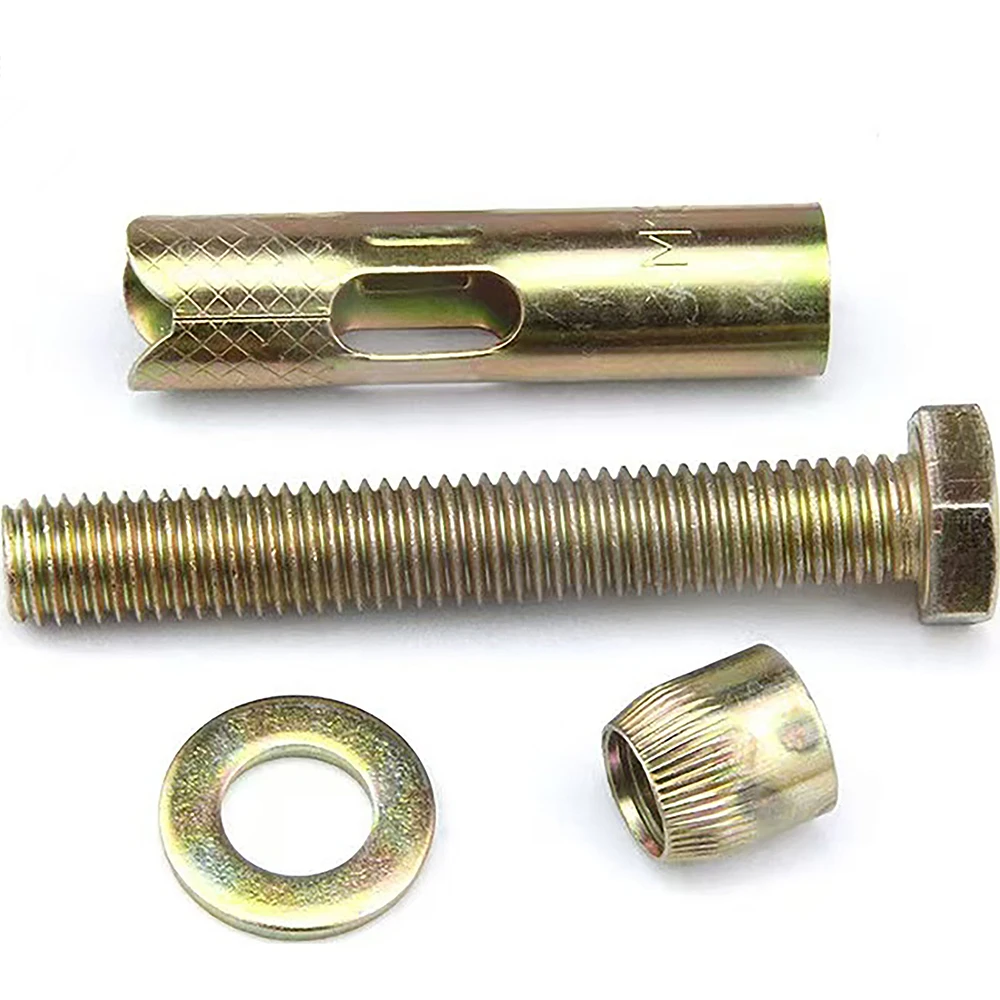
Option A: Heavy Duty Concrete Anchors (fluted sleeve, ribbed shank)
The product description for Boen's Heavy Duty Concrete Anchors gives these features:
- Anti-rotation design: A fluted sleeve surface bites into the concrete to stop spin-out during tightening (the description cites ISO 16047). It states 95% torque retention, compared with 40–60% for smooth anchors.
- Vibration resistance: The description states the anchor withstands more than 10⁶ cyclic loads and references ISO 16130.
- Grip strength: A ribbed shank is described as raising pull-out resistance by 35%. The quoted test data is M10: 17.2 kN, against 12.7 kN for a smooth sleeve, with reference to ASTM E488.
- Corrosion protection: Zinc-plated carbon steel (ISO 4042 compliant per the description), with 500+ hours of salt spray resistance quoted under ISO 9227.
- Installation: Single-step expansion: drill, insert, tighten.
- Listed applications: High-vibration machinery (CNC bases, compressor mounts), steel column base plates (AISC 360), bridge expansion joints, seismic bracing, cell tower foundations and solar racking.
Best fit: Buyers who need heavy duty anchor bolts for concrete under vibration, such as machinery and conveyor bases, and who want a simple installation sequence.
Option B: Concrete Anchors (post-installed single-tube undercut)
The Concrete Anchors description covers an undercut anchor that works by mechanical interlock. Its published installation sequence is:
- Drill the hole to the specified diameter and depth with a standard rotary hammer, then vacuum out the debris.
- Expand the base cavity with an undercutting drill bit. The description says this step is mandatory for mechanical interlock.
- Insert the anchor assembly until it is flush with the substrate surface.
- Tighten the nut to 35 Nm to activate cone expansion.
Listed application areas include steel-to-concrete connections (steel column base plates per AISC 360, bridge bearing assemblies per AASHTO LRFD, precast wall connections per PCI Design Handbook) and seismic bracing (hospital equipment anchorage per IBC 1705.3, pipe and tray supports in earthquake zones).
Best fit: Structural steel-to-concrete and seismic bracing projects where the crew can carry out the extra undercutting step with the right drill bit.
Step 3: Match criteria to the application
| Criterion | Heavy Duty Concrete Anchors (fluted sleeve) | Concrete Anchors (undercut) |
|---|---|---|
| Holding principle | Fluted sleeve and ribbed shank expansion | Mechanical interlock in an undercut cavity |
| Stated focus | Vibration and anti-rotation | Structural connections and seismic bracing |
| Installation tooling | Drill, insert, tighten | Rotary hammer plus mandatory undercutting bit |
| Stated torque value | 35 Nm nut tightening | |
| Corrosion protection | Zinc-plated carbon steel, 500+ h salt spray stated | |
| Published test data | M10 pull-out figures stated |
When a recommendation does not apply
- If your substrate is not concrete, for example cinder block, brick or hollow masonry, neither description supports that use. Ask for a confirmed specification first.
- If the crew cannot use an undercutting drill bit, the undercut anchor's required installation step cannot be completed.
- For harsh corrosive or marine exposure, zinc plating may not be enough for your project's requirements. Confirm the coating and material with the supplier and your engineer.
- If your design needs load values for a diameter or embedment not covered here, do not take the M10 figures as representative. Request the matching spec sheet.
Step 4: Confirm before ordering
Both product pages say detailed specifications are available on request and spec sheets can be customized. Ask for:
- Available diameters, lengths and embedment depths for your size range
- Test reports behind the quoted standards and load figures
- Material and coating details, especially for the undercut anchor
- Installation torque and hole dimensions for each size
- Packaging and export documentation requirements
This guide does not confirm prices, lead times or certifications. Get those directly in your quotation, and have a qualified engineer check the final anchor selection for structural or seismic work.
THE PEOPLE

About the author
THE COMPANY
Handan Boen Fastener Manufacturing Co., Ltd.
Handan Boen Fastener Manufacturing Co., Ltd. (Est. 2010) specializes in producing standardized industrial fasteners, including bolts, nuts, washers, and other essential components. We provide cost-effective for small and medium-sized buyers in industries such as automotive parts, agricultural machinery, and construction. Why Choose Us? No Quality Anxiety: ISO 9001-certified quality control + 100% inspection process, ensuring tensile strength tolerance within ±5%.…
About Us ↗Visit company website ↗YOUR NEXT STEP
Bring your brief. Start a useful conversation.
Use case, specification, quantity and delivery window: make the next conversation specific.
Who We Are: The Right Fastener Partner for Global SMEs
Handan Boen Fastener Manufacturing Co., Ltd. (Est. 2010) specializes in producing standardized industrial fasteners, including bolts, nuts, washers, and other essential components. We provide cost-effective for small and medium-sized buyers in industries such as automotive parts, agricultural machinery, and construction.